

Lumbini
About
Overview
Lumbini (pronounced Lumbinī, meaning “the lovely”) is one of the holiest Buddhist pilgrimage sites in the world and the birthplace of Siddhartha Gautama, who later attained Enlightenment as Shakyamuni Buddha, the founder of Buddhism. Located in Rupandehi District of Lumbini Province, southern Nepal, Lumbini holds unparalleled spiritual, historical, and cultural significance for Buddhists and peace-seekers worldwide.
According to Buddhist tradition and ancient texts, Queen Maya Devi gave birth to Siddhartha Gautama here around 624 BCE. Lumbini is one of the four sacred sites directly connected to the life of the Buddha, alongside Bodh Gaya (Enlightenment), Sarnath (first sermon), and Kushinagar (Parinirvana). In recognition of its universal value, Lumbini was inscribed as a UNESCO World Heritage Site in 1997.
Cultural, Spiritual, and Historical Significance
Lumbini is revered as the exact birthplace of the Buddha, confirmed by the Ashoka Pillar, erected in the 3rd century BCE by Emperor Ashoka of the Mauryan Empire. The pillar’s Brahmi inscription explicitly identifies Lumbini as the Buddha’s birthplace and records Ashoka’s pilgrimage and patronage.
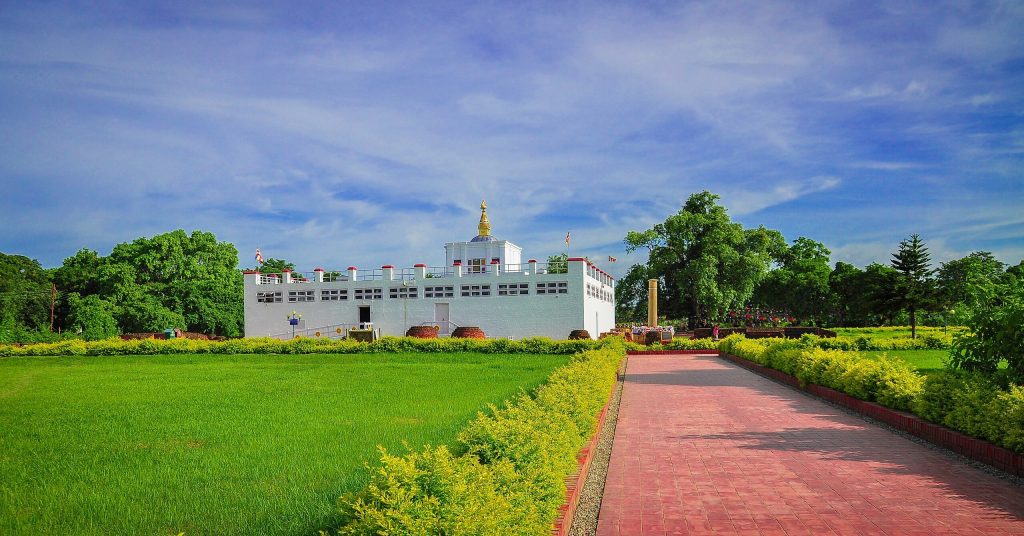
The site is centered on the Sacred Garden, which includes the Mayadevi Temple, the Marker Stone believed to indicate the precise birth spot, and the Nativity Sculpture depicting the Buddha’s birth. Nearby lies the Puskarini (Sacred Pond), where Queen Maya Devi is believed to have bathed before childbirth and where the newborn Buddha took his first ritual bath.
Over centuries, Lumbini has remained a symbol of peace, compassion, and non-violence, attracting monks, scholars, and pilgrims from across Asia and the world. Ancient Chinese pilgrims such as Faxian and Xuanzang documented the site, preserving its importance through history.
What Visitors Can Expect
Visitors to Lumbini experience a serene and contemplative environment designed for reflection and spiritual practice:
- The Mayadevi Temple, marking the Buddha’s birthplace
- The Ashoka Pillar, one of the earliest archaeological proofs of Buddha’s life
- Peaceful monastic zones with monasteries built by different countries
- Chanting, meditation, and rituals performed by pilgrims from around the world
- The World Peace Pagoda, Lumbini Museum, and International Research Institute
- A calm, car-free Sacred Garden, emphasizing silence and reverence
Lumbini’s layout reflects harmony and global Buddhist unity, with monasteries representing Theravāda, Mahāyāna, and Vajrayāna traditions.
Location & Geographic Details
- Place Name: Lumbini – Birthplace of Lord Buddha
- District: Rupandehi District
- Province: Lumbini Province
- Country: Nepal
- Coordinates: Approx. 27.4706° N, 83.2756° E
- Region: Southern Nepal, Terai plains
- Nearby Landmark: Close to the Nepal–India border (near Siddharthanagar/Bhairahawa)
Lumbini lies about 22 km west of Siddharthanagar (Bhairahawa) and is easily accessible from northern India and central Nepal.
Visitor FAQs
Q: Why is Lumbini important?
A: Lumbini is the birthplace of Siddhartha Gautama (Lord Buddha) and one of the four most sacred Buddhist pilgrimage sites in the world.
Q: Is Lumbini a UNESCO World Heritage Site?
A: Yes. Lumbini was designated a UNESCO World Heritage Site in 1997.
Q: How can I reach Lumbini?
A: Lumbini can be reached by road from Bhairahawa (Siddharthanagar). The nearest airport is Gautam Buddha International Airport, about 20 km away.
Q: What is the best time to visit Lumbini?
A: The best time to visit is October to March, when the weather is pleasant. Buddha Jayanti (April–May) is especially significant.
Q: Can non-Buddhists visit Lumbini?
A: Yes. Lumbini welcomes visitors of all faiths. Silence, modest dress, and respectful behavior are encouraged.
Q: What are the main attractions in Lumbini?
A: Key attractions include the Mayadevi Temple, Ashoka Pillar, Sacred Garden, Puskarini Pond, monastic zones, and World Peace Pagoda.